nickskitchen.com
Homemade Croissant Recipe
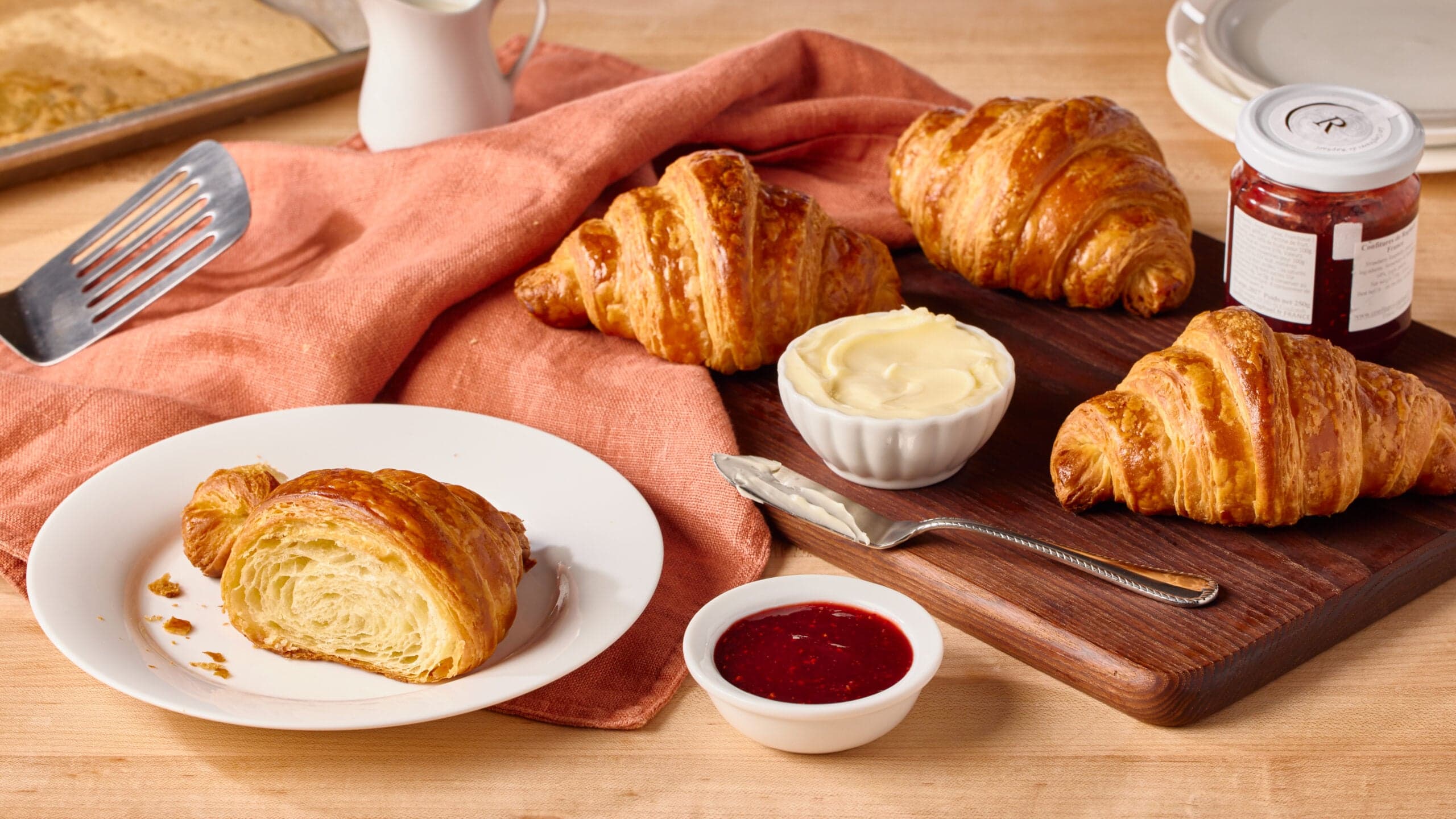
Homemade croissants are a true labor of love, and my step-by-step recipe breaks the process down into clear, manageable stages. With careful lamination, proper rest times, and temperature control, you’ll create croissants with crisp, flaky layers and a rich, buttery interior that rivals your favorite Parisian bakery. Take your time, follow the process, and trust that the payoff is more than worth it!
Prep
2h
Cook
40 min
Total
24h 40m
Serves
8
Instructions
- 01
Build the dough base (24 hours before eating). In the base of a stand mixer fitted with the dough hook, add 303 grams of flour, 302 grams of bread flour, 66 grams of sugar, 12 grams of salt, and seven grams of active dry yeast. Mix to combine. Make a well in the flour mixture, then pour in 214 grams of water and 120 grams of whole milk. Mix on medium-low until you’ve got a tight, raggedy ball (about five minutes). Remove the hook, and cover the bowl with a damp towel. Let the dough rest for ten minutes. (The ten-minute rest is like a mini spa day for your gluten — it relaxes the dough so it rolls out easier later.)
- 02
Place the hook back on the stand mixer. With the mixer on medium-low, add 57 grams of unsalted European butter, cut into ½-inch pieces. Mix until the dough is silky, elastic, and not sticky, eight to ten minutes. If the dough looks greasy, you’ve overmixed. Stop as soon as it’s smooth and stretchy.
- 03
Form the dough into a ball and place it seam-side down in the mixing bowl. Cover with a damp towel or plate. Place the covered bowl in the refrigerator and chill for at least four hours, and up to 12 hours.
- 04
Using a sharp knife or kitchen shears, cut an “X” in the rested dough. Let rise at room temperature until about one and a half times its original size, about one to two hours. This will help the dough rise into a square shape and make it easier to roll out later.
- 05
18 hours before eating, lay out three large pieces of plastic wrap — all facing the same direction. Place the dough square in the center. Fold the plastic wrap around the dough, like a gift, and flip it over. Using a rolling pin, roll the dough into the corners of the plastic wrap. Rolling inside the wrap helps achieve another perfect eight-inch square with straight sides and right angles. Freeze the dough for 25 minutes.
- 06
Butter block. Meanwhile, place two 13 X 18 pieces of parchment paper on a clean work surface. Using a sharpie and a ruler, draw an eight-inch square on one piece of parchment. Place the butter pieces side by side in the center of the square between the parchment sheets. Ensure the square is on top, and use a rolling pin to tap and roll the butter into a half-inch-thick, eight-inch square. Try to avoid air pockets and keep the edges as straight as possible — the more precise now, the flakier your croissants will be later. Once a perfect butter square is achieved, wrap the butter between the parchment, like a gift. Refrigerate.
- 07
Combine the butter and dough. The goal is to have slightly colder dough than butter. If the butter is too cold, it shatters; if the dough is too warm, the butter melts. Remove the dough from the freezer and, on a lightly floured surface, roll it out into a 16 x 8-inch rectangle. Maintain sharp edges and right angles. Remove the butter from the fridge and unwrap it. Place the butter in the center of the dough.
- 08
Make a butter packet. Fold the edges of the dough to meet in the center over the butter. The dough should touch, but not overlap. Pinch all seams together (center, top, and bottom) to fully conceal the butter. Lift the butter packet and dust off any flour. Place it seam-side vertical. Roll the packet lengthwise into a ¼-inch thick, 24-inch long rectangle. Lift and move the dough often while rolling — sticking and ripping will compromise the layers. Keep edges straight and corners at right angles. Trim any ragged edges.
- 09
Make a book fold. Fold the short ends of the dough to meet in the center, leaving a tiny gap in between. Then fold the dough in half like a book. This first fold is a double turn, quadrupling the layers — four layers in one step. Wrap in plastic wrap, freeze for 20 minutes, then refrigerate for one hour.
- 10
Make the letter fold. Remove the dough from the fridge, and tap with a rolling pin to flatten. If any air pockets appear, pierce them with a toothpick or cake tester. Roll the dough into a long rectangle, ⅜-inch thick. Fold in thirds, like a letter. Pull on the edges to square them if they're rounded. Wrap tightly in plastic wrap and use a rolling pin to straighten the edges inside the wrapping. Freeze for 20 minutes, then refrigerate for one hour.
- 11
Roll and rest. Remove from the fridge and tap with a rolling pin to flatten. Roll the dough into a perfect 14 x 17-inch rectangle, with straight edges and 90° angles. Wrap in plastic wrap, freeze for 20 minutes, then refrigerate overnight or for at least eight hours.
- 12
Shape the croissants (about five hours before eating). Make a proofing oven: move oven racks to the upper and lower thirds. Heat water to a simmer in a skillet, then place the skillet on the oven floor and close the door. Line two baking sheets with parchment or Silpat liners.
- 13
Remove the dough from the refrigerator and let it rest for five minutes. Roll to 17 x 14 inches. Trim uneven edges where butter and dough don’t line up. Trim to a perfect 16 x 14 rectangle. Using a dough cutter and ruler, cut into four four-inch wide strips. Then cut each strip corner-to-corner into two triangles. Slightly trim the base of each triangle at a gradual angle. Stretch the base to three inches wide and gently lengthen the dough toward the tip. If the dough gets too soft, freeze briefly — better to pause than smear butter.
- 14
Roll each crescent from base to tip, concealing the tip underneath. Place on prepared sheet pans, four rolls per pan. Loosely cover with plastic wrap. Place pans in the proofing oven (70–75°F or 21-24°C). Any hotter, and the butter melts, leading to dense croissants. Proof two to two and a half hours, until doubled, puffy, and jiggly. Resist poking — they’re delicate.
- 15
Once proofed, uncover and refrigerate croissants for 20 minutes. Preheat the oven to 350°F (177°C). Mix one large egg yolk and one tablespoon of heavy cream until smooth. Brush tops (not exposed cut sides) with egg wash.
- 16
Bake for 25 minutes. Rotate pans, then bake 10–15 minutes more, until golden brown. Cool on the sheet pan. Eat within two hours for the best flavor. To revive later, reheat in a 325°F (163°C) oven for five to eight minutes.
Nutrition
per serving · 1 serving
- Calories
- 687
- Protein
- 10g
- Carbs
- 66g
- Fat
- 43g
- Fiber
- 2g
- Sugar
- 9g
- Sat. fat
- 27g
- Sodium
- 866mg
- Cholesterol
- 134mg
Free · No ads
Save this recipe to your own library.
iCook.ing is a free recipe library. Create an account in 10 seconds to save this recipe, plan your week, and head to the store with one shopping list.
Save from anywhere
Paste a link from a recipe blog, Instagram, TikTok, Facebook, or Pinterest — we pull the ingredients, steps, and photo.
Plan your week
Drag recipes onto a weekly plan, scale for the number of people you're feeding, and never wonder what's for dinner.
One shopping list
Your plan rolls up into a single, de-duplicated shopping list — sorted by aisle so the store run is faster.
Cook, don't scroll
Big, screen-stays-awake cook mode with built-in timers. No ads. No life story above the recipe.