bakingwithbutter.com
Homemade Croissants Step-by-Step
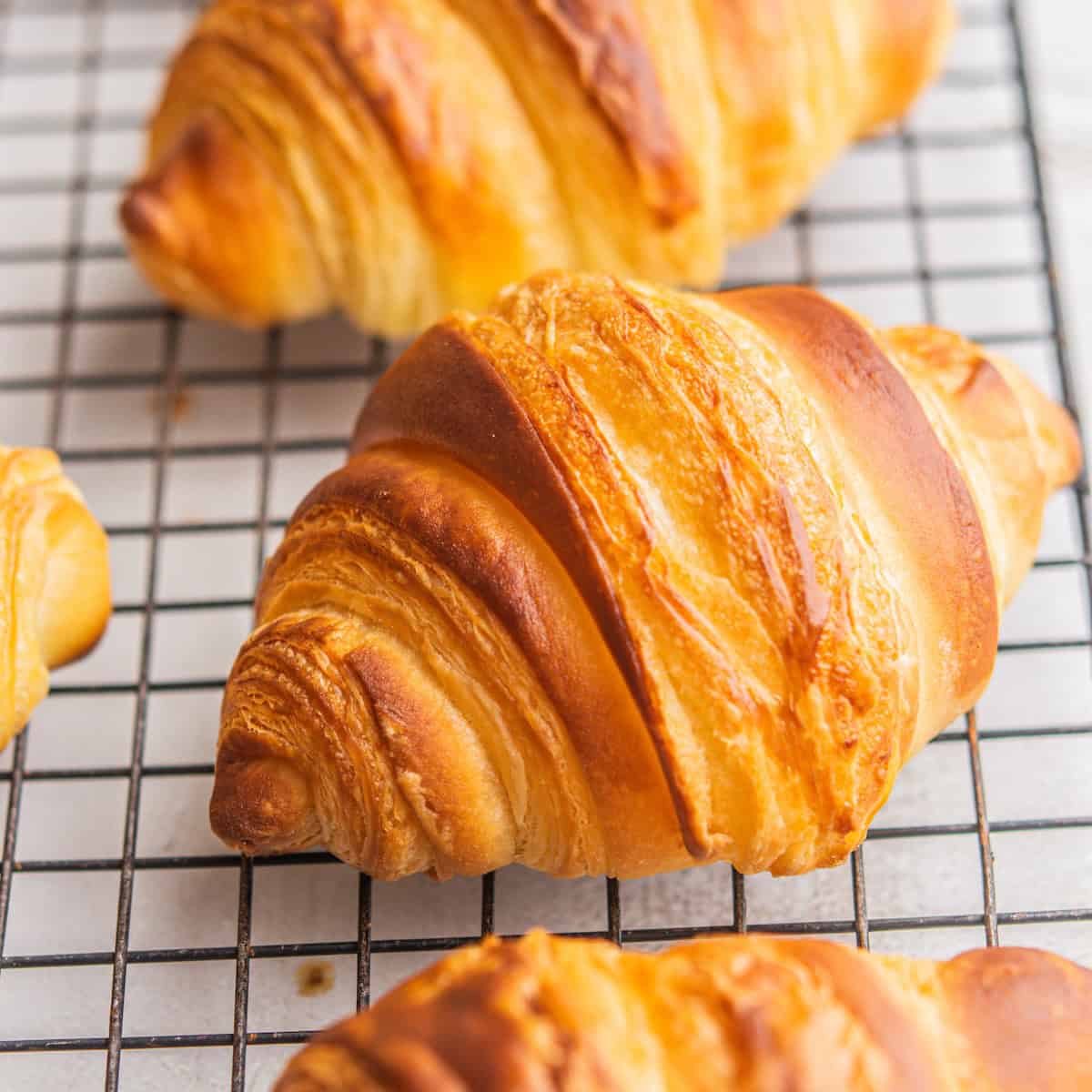
Croissants require a bit of patience and precision but this detailed recipe will walk you through each step so you can make them successfully at home. They’re flaky, buttery and oh-so-delicious.
Prep
30 min
Cook
20 min
Total
24h 50m
Serves
12
Instructions
- 01
In a large bowl add the milk, water, yeast and sugar. If using active dry yeast, let it sit for 5-10 minutes until frothy. Skip this step if using instant yeast.
- 02
Add the flour and salt and combine until a rough dough forms.
- 03
Turn the dough onto a lightly floured surface and begin kneading. Work the dough for about 3 minutes to start developing the gluten. The dough should become smoother and less sticky.
- 04
Once the gluten has begun to develop, add the 30g of room temperature butter to the dough. Continue kneading for another few minutes until the butter is fully incorporated.
- 05
Roll it into a rough rectangle, wrap it in plastic, and refrigerate for at least 2 hours or overnight.
- 06
Mix 250g butter with 1 1/2 tbsp flour until combined.
- 07
Place the butter between two sheets of parchment paper and roll it into a 20x15cm (8x6 inch) rectangle, about .5 cm (1/4 inch) thick. To get clean, straight edges, fold the edges of the parchment paper around the butter block to create a square frame, then press the butter with the rolling pin to fit neatly into this frame.
- 08
Refrigerate the butter block until it’s firm.
- 09
Remove your butter block from the fridge and roll it in the parchment paper a bit with the rolling pin to make it pliable and mouldable. It should be cold but be able to be bent a bit.
- 10
On a floured surface, roll the chilled dough into a 20x32 cm (8x12.5 inch) rectangle. The dough should be twice the height of the butter, and around the same width.
- 11
Place the butter block in the center of the dough, folding the top and bottom edges over the butter to fully encase it like a letter. Press this seal closed with your fingertips. Use a sharp knife to make shallow slits along the edges of the dough. This helps prevent excessive tension in the dough, especially if it's slightly too tight around the butter block.
- 12
Turn it 90 degrees so the crease where you encased it is vertically in front of you.
- 13
First fold: Applying gentle pressure, roll the dough into long rectangle about 6mm thick. Don't worry about how wide it is. Always roll forward with gentle, even pressure and focus on length not width. Avoid pushing too hard, which can tear the dough and crack the butter layers. Ensure the dough is not sticking to the bench, and dust with more flour if needed.
- 14
Once rolled, cut off the uneven top and bottom edges. Brush away excess flour on the dough.Fold the top third of the dough down and the bottom third up, like folding a letter. Wrap in plastic, and refrigerate for 30-60 minutes.
- 15
Second fold: Place the dough so it's vertically infront of you. Repeat the rolling process as before. Cut off scraggly or uneven bits of dough to maintain clean, sharp edges. Fold into thirds, turn, wrap, and refrigerate for 30-60 minutes.
- 16
Third fold: Repeat the folding process one more time, then refrigerate for at least 2 hours.
- 17
After the final rest, roll the dough into a 60x30 cm (24x12 inch) rectangle, about 5 mm (1/4 inch) thick.
- 18
Mark 5 cm (2 inches) intervals along the top and bottom edge of the dough rectangle. Cut diagonal lines connecting the top marks to the bottom marks to form triangles. You should get around 12 triangles and two off cuts.
- 19
Gently stretch each triangle, especially along the base. Starting from the wide base, roll the triangle toward the tip. Tuck the tip under the croissant to secure it and curve the edges into a crescent shape.
- 20
Place the croissants on baking trays lined with parchment paper. Cover loosely with plastic wrap or a towel and let them proof for 2-5 hours at room temperature, until doubled in size and visibly puffy. If you shake the tray gently the croissants should jiggle.
- 21
Preheat the oven to 200°C/400°F.
- 22
Whisk the egg with a tablespoon of water and use a pastry brush to brush the tops of the croissants with the egg wash.
- 23
Bake the croissants for around 20-22 minutes until deeply browned. Croissants are great served fresh on the day they are baked. The layers in the croissants will be most prominent if the croissant has cooled down to room temperature before slicing.
Nutrition
per serving · 1 croissant
- Calories
- 351
- Protein
- 6g
- Carbs
- 36g
- Fat
- 20g
- Fiber
- 2g
- Sugar
- 5g
- Sat. fat
- 12g
- Sodium
- 307mg
- Cholesterol
- 67mg
Free · No ads
Save this recipe to your own library.
iCook.ing is a free recipe library. Create an account in 10 seconds to save this recipe, plan your week, and head to the store with one shopping list.
Save from anywhere
Paste a link from a recipe blog, Instagram, TikTok, Facebook, or Pinterest — we pull the ingredients, steps, and photo.
Plan your week
Drag recipes onto a weekly plan, scale for the number of people you're feeding, and never wonder what's for dinner.
One shopping list
Your plan rolls up into a single, de-duplicated shopping list — sorted by aisle so the store run is faster.
Cook, don't scroll
Big, screen-stays-awake cook mode with built-in timers. No ads. No life story above the recipe.