bitingatthebits.com
How To Make Easy Homemade Ramen Noodles From Scratch
This post covers everything you need to know to make the best springy, slippery, chewy homemade ramen (noodles) you've ever had. Every bowl of Japanese Ramen centers around the highest quality wheat-based alkaline noodles you can find (which aren't easy to come by here in Italy). That's where this simple ramen recipe comes in -- it relies on good measurements, a few basic pantry staples, and plenty of resting time to help make the ramen dough more pliable and much easier to work with.
Prep
5 min
Cook
3 min
Total
8 min
Serves
4
Instructions
- 01
Make the alkaline water. In a large measuring cup, add 1 cup of water, salt, and the baked baking soda and stir well to dissolve.
- 02
Make the ramen dough. Add the sifted flour to a large mixing bowl, add about 3/4 of the alkaline water, and stir in a circular motion with your hands to combine, adding more water slowly until the dough comes together and you can form a shaggy dough ball (*see photos in main post for what it should look like at this stage). Once the dough ball is formed, try your best to knead it for 2 or 3 minutes by hand (or in a stand mixer fitted with the dough hook for 1 minute only).
- 03
Rest the dough (1st time). Place the dough in a sealed bag, remove any air from it, and refrigerate the dough overnight.
- 04
Roll out the dough. Remove the dough from the refrigerator and cut it into 4 equal pieces. FYI, the dough will be much softer and pliable at this point after resting overnight. Working with one piece at a time, press the dough down with your hands to create a rectangle, and then use a rolling pin to get it just thin enough to fit into a pasta machine on the widest setting. Dust the dough with bread flour and run it through the pasta machine. Fold it in half and run it through the pasta machine again. Next, fold it like a business letter (into thirds) and run it back through the pasta machine again. Do this two more times repeating the "business letter folds" and running through the pasta machine until you have a smooth and much softer rectangular dough sheet.
- 05
Rest the dough (2nd time). Place the dough in a sealed bag, remove any air, and allow it to rest for 30 minutes at room temperature.
- 06
Roll out the dough sheets. Working with one dough sheet at a time, dust it with flour so it doesn't stick and run it through the pasta machine starting on the widest setting. Then roll into progressively thinner sheets until you reach the desired thickness (for me, this is setting #3 on a Marcato Pasta machine).
- 07
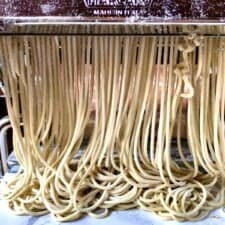
Cut the noodles. Attach the thinnest pasta cutter attachment to the pasta machine (the same one used for making cappellini or spaghetti), dust the dough sheet with flour so it doesn't stick to the machine, and run the sheet through to cut it into ramen. Dust noodles well with cornstarch to keep them from sticking together and create a nest. If you want curly ramen noodles, crinkle them with your hands by gently tossing them before letting them rest in a shaggy pile.
- 08
Rest the noodles. Rest the noodles in a sealed bag overnight in the refrigerator for the best flavor, or at least 1 hour before using them. Alternatively, you may place the noodles into a sealed bag and freeze them for up to 6 months or even longer if stored well.
- 09
Cook the noodles. Bring a large pot of unsalted water to a boil over high heat, add the noodles, and cook stirring with chopsticks or a spoon to prevent them from sticking together, for 1 to 3 minutes depending on the thickness of the noodles. Strain them and use them as the recipe directs. Enjoy!
Nutrition
per serving · 1/4 of recipe
- Calories
- 480
- Protein
- 16g
- Carbs
- 98g
- Fat
- 2g
- Fiber
- 3g
- Sugar
- 0.5g
- Sat. fat
- 1g
- Sodium
- 1675mg
- Cholesterol
- 0g
Variations & swaps
Substitutions
- Baked baking soda substitute: Use kansui (Japanese) or jian shui (Chinese) alkaline mineral water instead of homemade baked baking soda for making alkaline water in ramen noodles recipe.
- Bread flour substitute: Although technically possible, all-purpose flour can replace bread flour, though bread flour's higher protein content creates better chewy texture for homemade ramen noodles. I would never ever use all-purpose flour to make homemade ramen noodles, you shouldn't either, unless you are in a genuine pickle you cannot get yourself out of 😊.
- Cornstarch substitute: Potato starch can replace cornstarch for dusting homemade ramen noodles to prevent sticking during storage.
Variations
- Egg ramen noodles: (pictured directly above) Add eggs/yolks to the dough for an even richer color and slightly softer-textured homemade ramen noodle recipe*(recipe coming soon...they're delicious!)
- Thick chewy noodles: Use a lower hydration ratio and roll to pasta machine setting #2 on an Atlas Marcato pasta machine for extra thick, chewy ramen noodles
- Curly ramen noodles: After cutting, gently crinkle noodles with hands before resting to create a wavy, curly ramen noodle texture
- Different noodle widths: Use different pasta machine cutter attachments for varying noodle widths from thin to thick ramen styles
Free · No ads
Save this recipe to your own library.
iCook.ing is a free recipe library. Create an account in 10 seconds to save this recipe, plan your week, and head to the store with one shopping list.
Save from anywhere
Paste a link from a recipe blog, Instagram, TikTok, Facebook, or Pinterest — we pull the ingredients, steps, and photo.
Plan your week
Drag recipes onto a weekly plan, scale for the number of people you're feeding, and never wonder what's for dinner.
One shopping list
Your plan rolls up into a single, de-duplicated shopping list — sorted by aisle so the store run is faster.
Cook, don't scroll
Big, screen-stays-awake cook mode with built-in timers. No ads. No life story above the recipe.