thekitchn.com
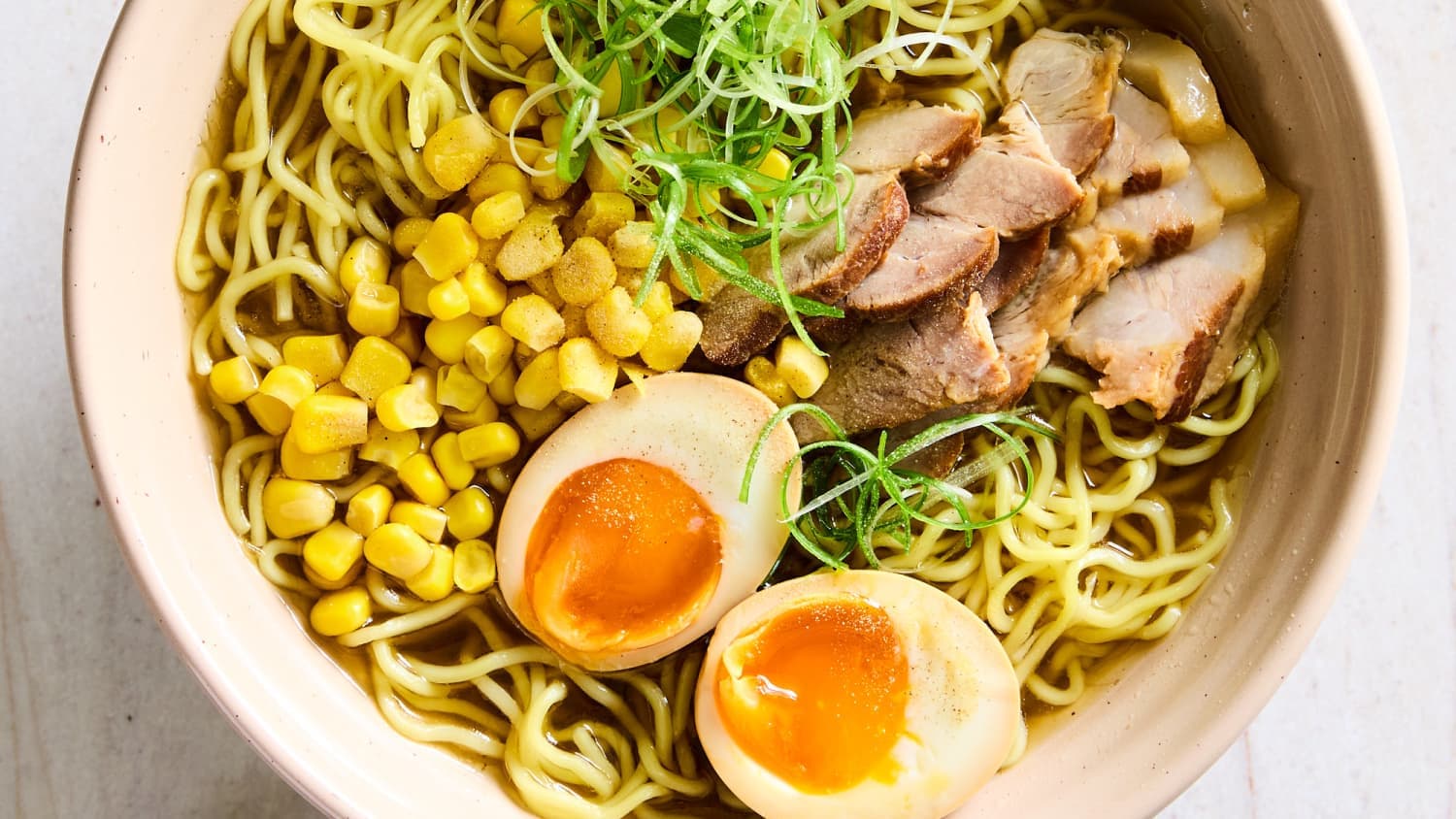
How To Make Homemade Shoyu-Style Ramen
With tender pork, jammy eggs, chewy noodles, and extra-flavorful broth, everyone will ask when you’re making this again.
Prep
—
Cook
—
Total
—
Serves
—
Instructions
- 01
Place 1 (1-pound) piece boneless pork shoulder in a medium saucepan. Prepare the following, adding each to the saucepan as you complete it: Trim and cut 1 medium Japanese or 1 small leek (all parts) crosswise into 3-inch pieces. Cut 1 (1-inch) piece ginger crosswise into 1/4-inch thick rounds (no need to peel). Crush 4 garlic cloves with the flat part of a knife and peel if needed.
- 02
Add 1 cup soy sauce, 1 cup mirin, 3/4 cup water, and 1/2 cup sake. Bring to a boil over high heat. Meanwhile, cut a sheet of aluminum foil that will fit inside the saucepan, then tear a little slit in the center.
- 03
Reduce the heat to maintain a simmer. Place the foil in the saucepan, pressing it directly onto the surface of the ingredients. Simmer for 30 minutes. (This is a good time to make the chicken stock.)
- 04
Remove the foil and set aside. Fip the pork, cover again with the foil, and simmer until knife tender, 1 to 1 1/4 hours more.
- 05
Turn off the heat. Remove the foil and flip the pork. Cover again with the foil and let cool in the liquid for 2 to 3 hours. Transfer the pork to a sheet of plastic wrap, tightly wrap it up, and refrigerate until ready to use.
- 06
Pour the cooking liquid (this is the tare) through a fine-mesh strainer set over a bowl; discard the contents of the strainer. Skim off the layer of fat at the top if desired (optional). Reserve the tare for the ajitsuke tamago and ramen broth.
- 07
While the chashu is cooking, make the chicken stock. Prepare the following, adding each to the same large pot as you complete it: Halve 1 small yellow onion. Slice 1 (1-inch) piece ginger crosswise into 1/4-inch thick rounds (no need to peel). Crush 6 garlic cloves with the flat part of a knife and peel if needed. Cut 1 (6-inch) piece dried kombu.
- 08
Add 1 1/4 pounds chicken bones, 11 1/2 cups water, and 3 dried shiitake mushrooms. Bring to a boil over high heat. Skim off any foamy impurities that rise to the surface with a mesh ladle or spoon (but be careful not to spoon out too much of the liquid). A lot of foam will appear in the first half hour to hour, but will slowly decrease. Simmer until the stock is clear and flavorful, 1 1/2 to 2 hours.
- 09
Fit a fine-mesh strainer over a medium saucepan or large heatproof bowl. Pour the chicken stock through the strainer and discard the contents of the strainer.
- 10
Fill a medium saucepan with water and bring to a boil over high heat. Slowly lower 4 cold large eggs into the water one at a time. Return to a boil. Reduce the heat to maintain a simmer and cook for 8 minutes. Meanwhile, prepare an ice water bath by filling a medium bowl halfway with ice and water.
- 11
Remove the eggs from the water with a slotted spoon and place in the ice water bath. Let sit until the eggs are cool to the touch. Peel the eggs and place in a container that will fit the eggs somewhat snuggly or a sandwich-sized plastic zip top bag.
- 12
Add enough reserved tare to halfway to cover the eggs (about 1/3 cup, but make sure there is at least 1 cup tare left for the broth). Add enough room temperature water so the liquid completely cover the eggs, then give it a gentle stir. If there is not enough tare to completely cover the eggs (i.e. if the container is large or you don’t want to use up a lot of the tare), lay a piece of paper towel over the top. The paper towel will soak up the tare and help marinate the part of the egg peeking out. Cover or press the air out of the bag and then seal.
- 13
Let the eggs marinate in the refrigerator for at least 2 but no more than 24 hours. (Remove the eggs from the marinade after 24 hours and refrigerate in a separate container.)
- 14
When ready to serve, bring a large pot of water to a boil. Meanwhile, place the chicken stock in a saucepan and return to a simmer over medium heat. For each serving (up to 4), place 3 1/2 tablespoons of the tare in a deep serving bowl (at least 4 cups). Unwrap and thinly slice the chashu. Halve the eggs lengthwise. Thinly slice 1 medium scallion. Drain 1 (7 to 8.5-ounce) can whole kernel corn. Finely grate 1 garlic clove. Cut 1 nori sheet into 4 squares.
- 15
Add 1 (3 to 4-ounce) portion ramen noodles for each serving desired to the hot water and cook according to package directions. Just before the noodles are done, ladle 1 1/4 cups of the hot chicken stock into each bowl and gently stir to combine; taste and season with more tare 1 teaspoon at a time as needed.
- 16
Drain the noodles very well, then add to the bowls. Arrange the chashu (you will have extra), egg, corn, scallion, nori, and garlic on top. Sprinkle with ground pepper if desired and serve.
- 17
Make ahead: The chashu, ajitsuke tamago, and chicken stock can be made up to 2 days ahead and refrigerated in separate airtight containers. If making the eggs more than a day ahead, remove the eggs from the tare after 1 day and refrigerate in a separate airtight container.For longer-term storage, place the plastic-wrapped chashu in a zip top bag and freeze for up to 1 month. The tare and chicken stock can be frozen for up to 3 months.Storage: Store leftover components in separate airtight containers for up to 2 days.
Nutrition
per serving · Serves 6
- Calories
- 1420
- Protein
- 100.2g
- Carbs
- 72.5g
- Fat
- 80.5g
- Fiber
- 6.8g
- Sugar
- 5.7g
- Sat. fat
- 27.1g
- Sodium
- 3235.7mg
- Cholesterol
- 0mg
Free · No ads
Save this recipe to your own library.
iCook.ing is a free recipe library. Create an account in 10 seconds to save this recipe, plan your week, and head to the store with one shopping list.
Save from anywhere
Paste a link from a recipe blog, Instagram, TikTok, Facebook, or Pinterest — we pull the ingredients, steps, and photo.
Plan your week
Drag recipes onto a weekly plan, scale for the number of people you're feeding, and never wonder what's for dinner.
One shopping list
Your plan rolls up into a single, de-duplicated shopping list — sorted by aisle so the store run is faster.
Cook, don't scroll
Big, screen-stays-awake cook mode with built-in timers. No ads. No life story above the recipe.